Wales has an ambitious target: a zero-carbon screen sector by 2050. This is no longer a distant goal; it’s a coordinated effort. Bringing together industry, academia and government, the Screen New Deal: Transformation Plan for Wales is piloting practical ways to put sustainable practices into action across the sector, guided by recommendations across four themes: energy and fuel resources, rethinking transport, a circular film industry, and information creation and dissemination.
At the heart of that work are Media Cymru, an innovation programme led by Cardiff University and supported by us at Creative Wales, and Ffilm Cymru Wales. Greg Mothersdale from Media Cymru and Louise Dixey from Ffilm Cymru Wales explain how collaboration is helping to introduce sustainable practices across the sector.
Over the last four years, Media Cymru has invested millions of pounds into hundreds of research and development projects across Wales, guided by four pillars: fair, green, global and growth. Its green work spans both on-screen and off-screen sustainability, addressing the sector’s environment impact through targeted initiatives.
‘We are not just about growth at all costs,’ Greg says. ‘We advocate for inclusive, sustainable media, not growth which damages people or the planet.’
Ffilm Cymru Wales shares that ambition, with a focus on positioning Wales as a leader in sustainable green practice. ‘Our ambition is for climate action to be embedded across film development, production and exhibition, with climate storytelling supported alongside carbon reduction,’ says Louise.
So what is the Screen New Deal: Transformation Plan for Wales?
The Welsh transformation plan builds on the BFI National Lottery-funded Screen New Deal report of 2020 , which sets out a vision for a sustainable UK film and TV industry. In Wales, that vision has evolved into a practical roadmap designed to turn film and television in Wales into a zero-carbon, zero-waste sector by 2050.
For Louise, the impact has been immediate. ‘The plan has been vital in galvanizing our screen sector to collaborate on tackling the climate crisis together,’ she says.
Although rooted in Wales, the framework has been shaped as a blueprint for other UK nations and regions. For a country with fast-growing creative industries and ambitious sustainability targets, it signals both an opportunity to lead and a responsibility to deliver.
Who are the key partners?
The research was commissioned by BFI National Lottery Research and Statistics Fund. BAFTA albert led the project, with Arup conducting data gathering and analysis, working alongside Ffilm Cymru Wales, Media Cymru and Creative Wales.
‘We continue to meet quarterly with Creative Wales, Ffilm Cymru Wales and the Cardiff Capital Region who support our programme,’ says Greg. ‘These relationships enable knowledge exchange and best practice, both within and outside Wales.’
The impact is visible across a range of projects that supports the plan’s priorities:
- The Sustainability Coordinator Scheme: Developed from productions such as Havoc, it builds a talent base through high-end TV and film sustainability coordinator training, leading to placements. ‘It’s a great example of collaboration: The University of South Wales, Severn Screen and Earth to Action developed the training, then Creative Wales funded the placements,’ explains Greg – supporting a change in culture within the industry.
- Rusty Design’s Future Proof Props: Now on BAFTA Albert’s sustainable supplier list, it has reimagined prop development – addressing a plan priority of waste production and circular resource use. ‘They’ve made everything from the front end of a Formula One car to a table football player in far more sustainable ways ,’ Greg says .
- Wolf Studios Wales: Home to His Dark Materials and Industry, teams have implemented new technologies to significantly reduce and recycle water – learning lessons that can be shared with other major studios along the way.
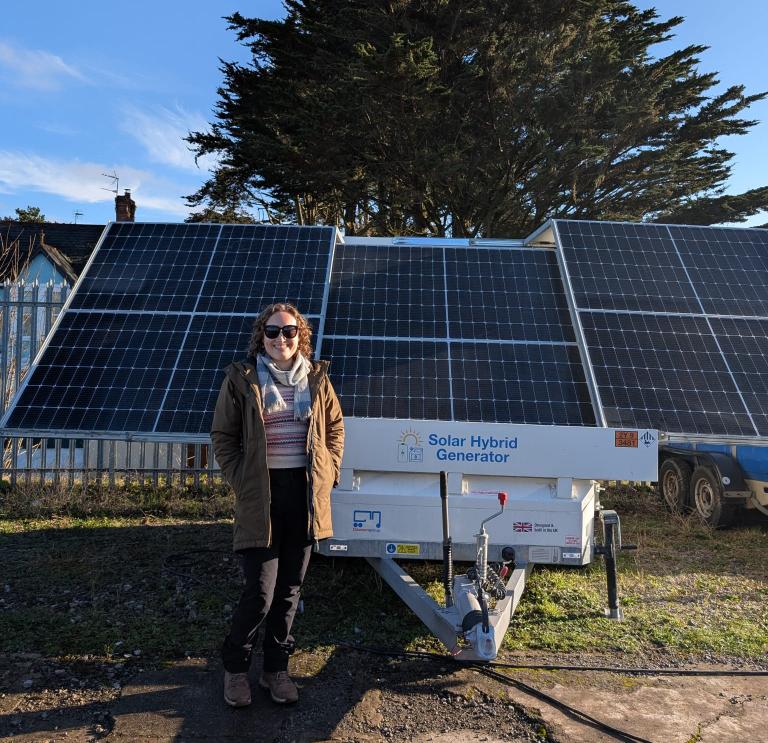
- Afanti’s Afango initiative: A net-zero production power programme successfully powering S4C productions using green hydrogen generators, advanced batteries, mobile EV charging, and responsibly sourced biofuel – supporting the transformation plan priority to eliminate diesel and transition to clean power.
- The Production Guild of Great Britain’s (PGGB) Welsh Committee – Partnered with Media Cymru, Ffilm Cymru Wales and Creative Wales to host a sustainability showcase at Great Point Studios, which is powered by a wind turbine. ‘It provided an opportunity for the industry to witness sustainable solutions and meet with some of the companies we have supported,’ says Greg.
On the ground, Louise sees the changes firsthand. ‘As the development agency for Welsh film, we are perfectly placed to seed environmental sustainability across the sector, from writers weaving climate consciousness into their stories to cinema managers reducing waste with reusable popcorn holders.’
She adds, ‘Through our Beacons short film scheme, we provide training on sustainable production and content to all project teams, and our Climate Stories Fund projects will have guidance from a sustainability coordinator trained in Wales to deliver the Screen New Deal’s priorities.’
Greg Mothersdale, Media CymruWe are not just about growth at all costs, we advocate for inclusive, sustainable media, not growth which damages people or the planet.’
Why does the Transformation Plan matter for Wales?
Wales won the bid to implement this plan because of its fast-growing screen sector and unique commitment to sustainability under the Well-Being of Future Generations Act 2015, offering the chance to demonstrate measurable change.
‘Wales is the best place to do it. The plan has helped bring collaborators and actions together, allowing us to demonstrate our commitment to developing a sustainable media sector in Wales,’ says Greg.
He adds, ‘Support from Creative Wales shows that the Welsh Government is committed to backing the growing media sector in becoming more sustainable, providing the information and resources needed to meet our goals.’
Louise highlights the practical impact on productions, ‘With support from organisations like us, Creative Wales, and Media Cymru, more productions are running on clean power, using electric vehicles, and employing sustainability coordinators. These changes not only improve environmental sustainability but also create lasting benefits for the screen sector and local communities in Wales.’
Louise DixeyWith support from organisations like us, Creative Wales, and Media Cymru, more productions are running on clean power, using electric vehicles, and employing sustainability coordinators."
Tips for implementing sustainability initiatives in the screen sector
Greg’s advice on working more sustainably is straightforward: start with training. ‘You can use locally developed programmes, and BAFTA Albert also runs training throughout the year,’ he says.
From there, it’s about building momentum. Stay informed, connect with local providers and grow a network of practical, sustainable solutions to strengthen your local impact.
Wales already has the foundations in place, from anaerobic biodigesters for food waste to wind turbines powering major festivals and events. The task is now to integrate solutions into everyday production. As Greg puts it, challenges exist but together we possess the vision, expertise and commitment to develop solutions that achieve the plan’s goals.
Explore more articles on green film and TV projects [LINK to article] supporting Wales’ sustainable screen ambitions.